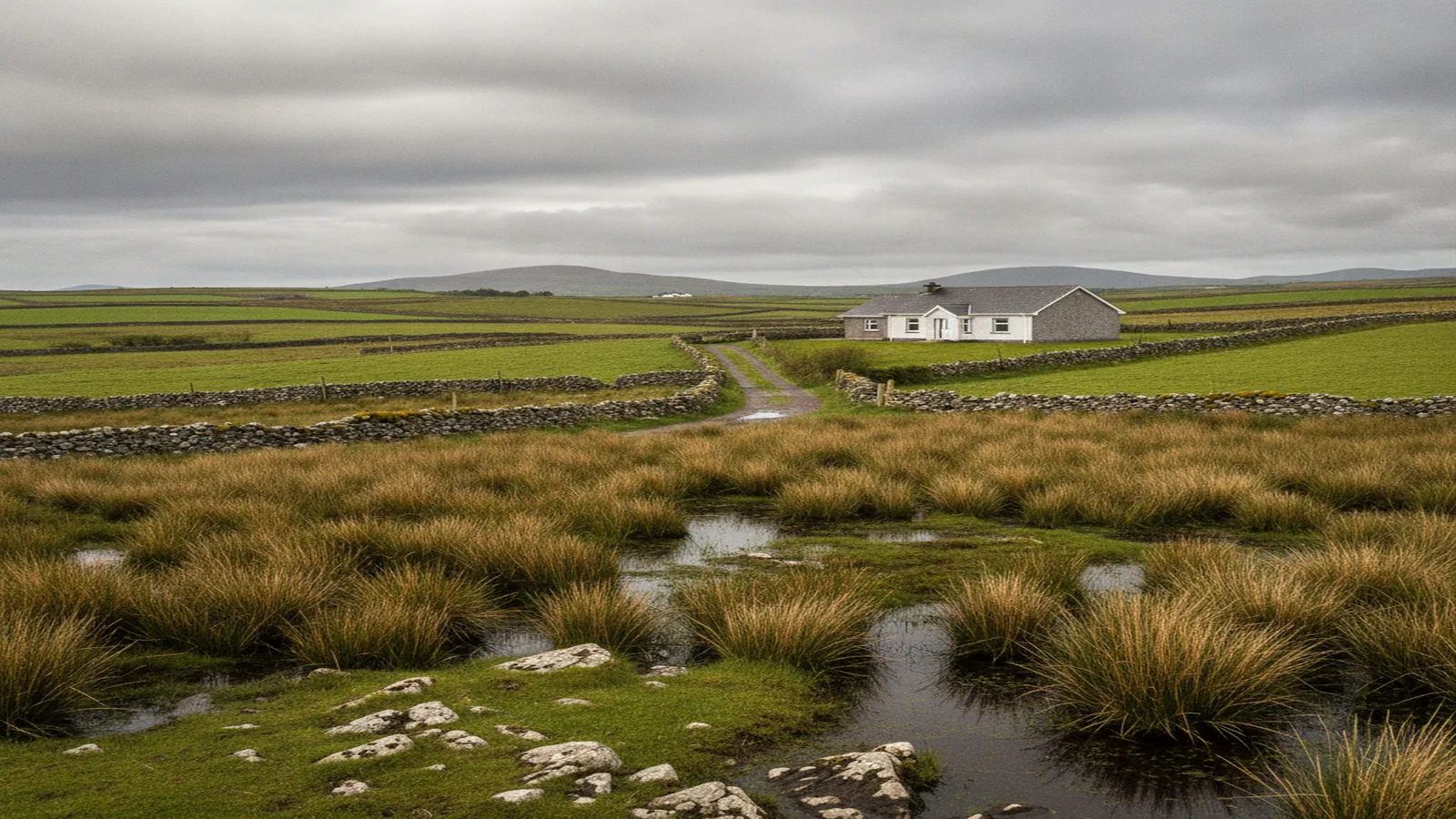
A contractor stands in the field behind the house, looks at the soft ground near the boundary wall, and tells you the system has had its day. He goes off to price the job. That evening you sit down to work out what it should cost, and the search results hand you a forum thread from England, a row on Facebook and a price list from a company in Kent.
That is the honest starting point for anyone looking up septic tank replacement cost Ireland: the number is decided by your site, and the firms who actually make and install the tanks quote job by job rather than publishing a list. Nobody is hiding anything from you. There is genuinely no Irish list price to find.
So this article does the next best thing. It sets out what moves the figure up and down, which numbers can be stood over because they come from the State, and which circulating figures you should put straight in the bin.
Why nobody publishes a septic tank replacement cost in Ireland
The main precast tank manufacturers in the Republic all work the same way. Their product pages carry specifications, capacities and drawings, and no prices. You send them the site details and they come back with a quote.
That is not evasion. A new domestic waste water treatment system (DWWTS) is not a product you lift off a shelf. It is a tank, a distribution arrangement, a percolation area sized to your soil, the excavation, the imported material, the reinstatement and the paperwork, and every one of those lines changes with the ground you own.
The figures that do circulate are worth naming so you can discount them. Homeowner anecdotes in Facebook threads are not price data. Numbers that appear in search result snippets often trace back to content sites that cite no source at all. And British prices cannot be converted across: the Republic has its own regime, its own Code of Practice and its own grant schemes, and there is no such thing here as the “septic tank ban” you will see on English pages.
If you want a real number for your own site, the route is a written quote against a completed site characterisation. You can ask us to put you in touch with a permitted operator and we will point you at people who work in your county.
What actually drives the cost of replacing a septic tank
The single biggest factor is not the tank. It is what your soil will accept.
Site characterisation is the assessment that settles it. A site assessor does a desk study, digs a trial hole and runs percolation tests, then records the result and recommends the system and the discharge route. The headline output is the percolation value, or PV, and the EPA Code of Practice for Domestic Waste Water Treatment Systems, which applies to assessments and installations carried out on or after 7 June 2021, ties the permitted system directly to that number.
A conventional septic tank with a percolation area is permitted at a PV of 3 to 50. A secondary treatment system with a soil polishing filter covers 3 to 75, or 3 to 90 in some configurations. Low pressure pipe distribution reaches 90, and drip dispersal reaches 120. Above 120 the site is unsuitable for any system discharging to ground, and a discharge to surface water instead needs a Water Pollution Act licence from the local authority.
Every step down that list is a more engineered system. The Code describes drip dispersal as requiring expert design, expert installation and increased maintenance. That is the sentence that moves a quote, far more than the size of the tank.
Slope and separation distances matter just as much. Site improvement works are not acceptable where the slope is steeper than 1:8, where the average percolation value across the three tests is above 120, or where the required separation distances cannot be met. Depth to bedrock and to the water table, proximity to wells and watercourses, and designations such as SACs and SPAs all sit in the same assessment.
Then come the things a digger driver will tell you about: access for a lorry and a machine, rock, how far the new percolation area sits from the house, what has to be dug up and put back, and whether the existing tank has to be de-sludged and decommissioned before anything else happens. None of that is exotic. All of it is money.
Where the 85% grant fits, and where it does not
This is where most people misread their position, so it is worth being exact.
The DWWTS grant pays 85% of the cost of the works, up to a maximum of €12,000. It rose from €5,000 on 1 January 2024, and the same change removed the old rule that the system had to have been registered by 1 February 2013. It is paid after the works have been completed to the local authority’s satisfaction, not before.
Two pieces of arithmetic follow from the cap, and they are arithmetic on the published grant terms rather than any claim about what your job will cost. You carry 15% of the eligible cost yourself, whatever the total. And once the eligible cost passes roughly €14,100, the €12,000 ceiling bites and every euro above that line is yours.
The part nobody explains clearly is that there are three separate schemes, made under S.I. No. 562, 563 and 564 of 2023, and you cannot simply apply because your tank is old.
One scheme covers works arising directly from an inspection under the National Inspection Plan and the advisory notice that follows a failure. The second applies in a Prioritised Area for Action, and the third in a High Status Objective Catchment Area, and for both of those you need a letter confirming eligibility before you can apply. You can check a High Status Objective Catchment Area by entering an Eircode in the map on gov.ie, and the person to ring in every case is the Rural Water Liaison Officer at your local authority. The Local Government Ireland grant page sets out the conditions.
Four more conditions catch people out. The house must have been built at least seven years ago, it cannot have had a DWWTS grant in the last seven years, it must be permanently occupied rather than a holiday home, and all works must be carried out in accordance with the EPA 2021 Code of Practice.
And one exclusion matters more than all of them: routine maintenance, servicing and de-sludging never qualify for a grant. There is more detail in our guide to the septic tank grant in Ireland.
Three situations, and what changes the number in each
These are composites of the situations that bring people to this site. They are not real customers and no figure below is a quote.
Take a 1970s bungalow outside Claremorris, Co. Mayo. The current owners bought the house years ago and the tank has never been de-sludged in their time, and nobody knows what size it is. The Code handles that: where the volume is unknown you assume 2.5 m³ and set the frequency on occupancy alone, which for a four person house is every two years.
What happens after the de-sludge is the part that decides the money. If the ground over the percolation area is still soft a fortnight later, the tank was never the whole story, and a new tank on its own will not fix a percolation area that has given up. We publish no emptying price for Co. Mayo, because no operator there publishes one.
Or a council letter lands about a house near Boyle, Co. Roscommon. Inspections come with at least ten working days’ notice, and local authorities inspect over a thousand systems a year on the EPA’s behalf. Typically about half fail, and a quarter are found to be a risk to human health or the environment.
If yours fails you get an advisory notice within 21 days setting out the reasons, the works needed and the deadline, and that same notice is the document that opens the first grant scheme. A re-inspection, if you disagree with the result, costs €20. And gov.ie says plainly there is “no question of imposing modern standards on older systems”, nor of anyone having to buy extra land to fix one. Our guide to septic tank inspections walks through the sequence.
Then there is the site in Co. Leitrim with heavy clay, where the percolation value came back too slow for a standard percolation area. Under the old 2009 Code that ended the conversation at 75. The 2021 Code added low pressure pipe distribution up to 90 and drip dispersal up to 120, so sites that were once simply unsuitable now have a route.
That route costs more. These are pressurised systems that need design input and more maintenance for the rest of their lives, and nobody, this site included, can tell you from a desk that your ground will take one. That is what percolation testing is for, and we have written separately about what to do after a failed percolation test.
The figures we publish, and the ones we will not
| Part of the job | What moves it | Do we publish a figure? |
|---|---|---|
| Registering the system | Fixed statutory fee | Yes. €50, at protectourwater.ie |
| Re-inspection if you dispute a result | Fixed statutory fee | Yes. €20 |
| Failing to register at all | An offence, fine on conviction | Yes. Up to €5,000 |
| Grant towards remedial works | 85% of cost, capped | Yes. Up to €12,000, paid after completion |
| De-sludging the old tank, Co. Galway | Town, tank size, access | Yes, attributed. A long-established Galway operator publishes €299 or €329 depending on town for a standard 3 m³ tank, and a second Galway operator quotes an average of €240 to €270 as of February 2025. Roughly €240 to €330 |
| De-sludging in Mayo, Roscommon, Sligo or Leitrim | Same drivers | No. No operator in those four counties publishes a rate |
| Percolation test and site characterisation | Site, access, assessor | No. No assessor in the region publishes a fee |
| The tank, the percolation area and the installation | Everything above | No. The manufacturers and installers quote per site |
That last row is the whole article in one line. A number we cannot source is worse than no number, because you would price your decision off it.
If you want the figures we can stand over gathered in one place, they are on our septic tank cost page.
What to do before you ask anyone for a price
Find your registration certificate first. If the system was never registered, it is €50 and it is a legal requirement, and a solicitor will look for that certificate the moment the house goes on the market.
Get the site characterisation done, and get it done by a site assessor rather than by whoever is quoting for the works. It is the document every quote should be priced against, and it is the only honest basis for comparing two prices.
Keep your de-sludging receipts. The law requires de-sludging to be carried out by a contractor holding a waste collection permit, and requires you to keep the evidence for five years. You can check any operator yourself on the National Waste Collection Permit Office register at nwcpo.ie before you let them near the tank.
Then get more than one quote, priced against the same assessment, and ask each one to separate the tank, the percolation area, the excavation and the reinstatement. If one quote is far lower, it is usually because it is pricing a different system.
When you are ready, tell us what the assessment says and we will put you in touch with operators who cover your county, or talk it through on . We do not carry out the works ourselves, and we are not the people who set the price. Our guide to replacing a septic tank covers what the process looks like from there.
Frequently Asked Questions
How much does it cost to replace a septic tank in Ireland?
There is no published national figure, and we will not invent one. The manufacturers and installers quote per site, because the cost is driven by your percolation value, your slope, your access and the type of system your site characterisation allows. Get a written quote against a completed site assessment, and get more than one.
Will the grant cover the whole cost of a new system?
No. The grant is 85% of the cost up to a maximum of €12,000, so you carry at least 15% yourself, and anything above roughly €14,100 of eligible cost falls entirely to you. It is also paid after the works are finished to the local authority’s satisfaction, so you need to be able to fund the job first.
Do I have to replace the tank if my system fails an inspection?
Not automatically. The advisory notice you receive within 21 days of a failure sets out the specific reasons and the works required, and that can be anything from a repair to a full replacement. Official guidance is clear that modern standards are not imposed on older systems where there is no evidence of risk to human health or the environment.
Does de-sludging or servicing qualify for the grant?
No. Routine maintenance, servicing and de-sludging are excluded from all three grant schemes, and that is stated on every official source. The grant is for remedial works arising from an inspection, a Prioritised Area for Action or a High Status Objective Catchment Area, not for keeping a working system running.