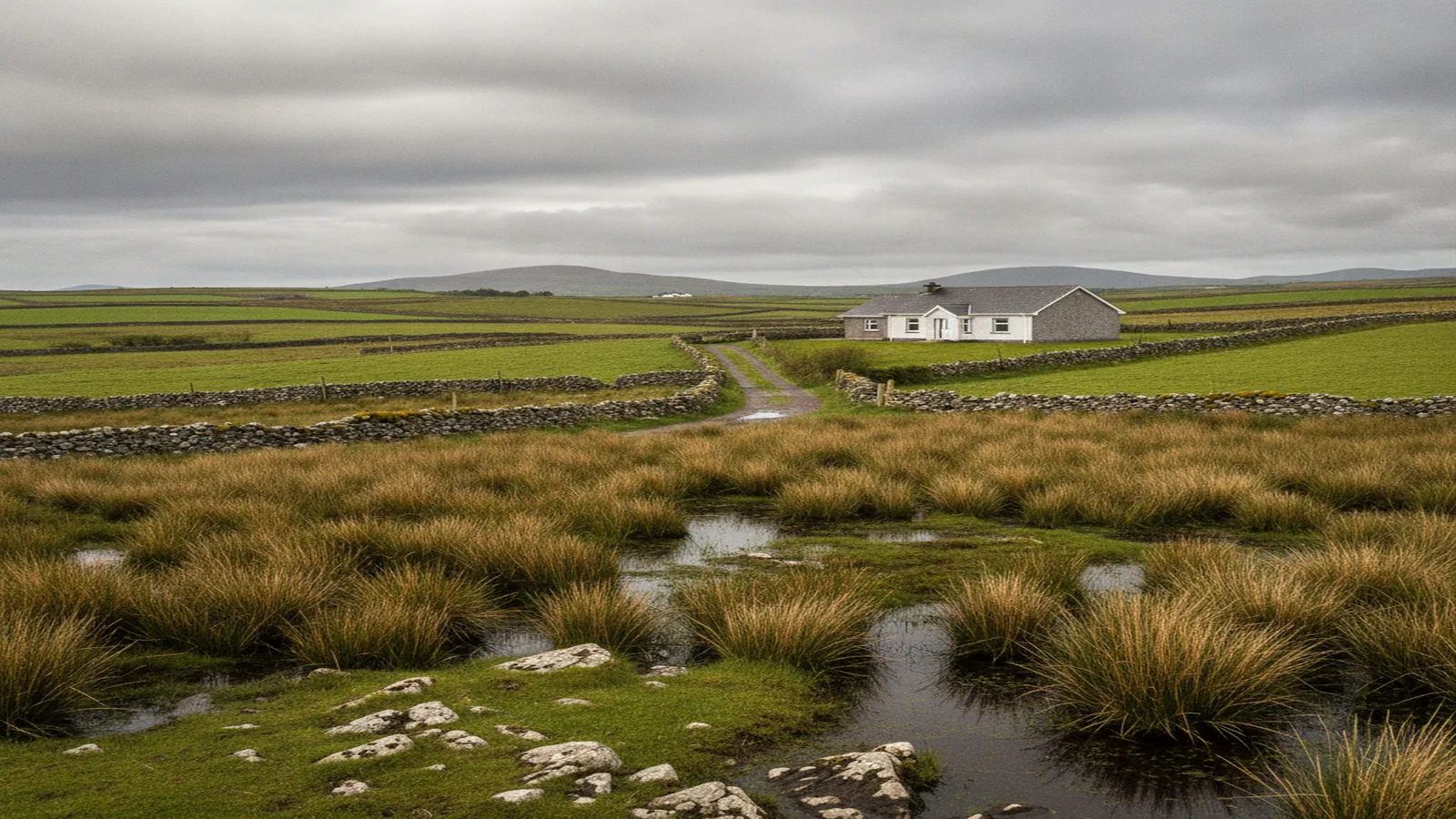
Two houses on the same road outside Ballinrobe, built fifteen years apart, can have completely different systems in the ground. One has a septic tank and a percolation area. The other has a powered treatment unit, a service requirement and a soil polishing filter. Nothing about the houses explains the difference.
The ground does. If you are weighing up a septic tank against a wastewater treatment system in Ireland, the decision comes down to one number measured on the site before anything is bought, and most homeowners never hear it until an engineer puts it in front of them.
A septic tank is one kind of domestic waste water treatment system, or DWWTS, which is the term the regulations use. Everything below applies to the Republic of Ireland only.
What decides between a septic tank and a wastewater treatment system
Before a system is chosen for a new or replacement installation, the site goes through a site characterisation. A site assessor does a desk study, digs a trial hole, and runs percolation tests. The result goes on a site characterisation form along with a recommendation for the system type and the discharge route.
That work is governed by the EPA’s 2021 Code of Practice for Domestic Waste Water Treatment Systems, which applies to site assessments and installations carried out on or after 7 June 2021. It replaced the 2009 Code, still valid only where the assessment or installation started, or planning was applied for, before that date. Compliance is required under the planning and building control systems, not optional.
The number that comes out of it is the percolation value, usually written as PV. It describes how fast water drains through the subsoil. Low numbers mean fast, high numbers mean slow, and both extremes cause problems.
If you are at the planning stage with no site characterisation yet, that is the first thing to sort out. Tell us where the site is and we will put you in touch with a site assessor working in your county. We publish no price for percolation testing, because no assessor in the West of Ireland publishes one and the figures on forums cite no source. Get it in writing.
What a septic tank can and cannot handle
A septic tank does primary treatment. Solids settle, a crust forms, and the liquid moves on to the percolation area where the soil does the real work. Nothing in it is mechanical, which is why a well-sited tank can run for decades on de-sludging alone.
Table 6.4 of the 2021 Code sets the limits. A septic tank with a standard percolation area is permitted where the percolation value is between 3 and 50. Below 3, water moves through the soil too quickly for treatment to happen, and importing slower subsoil may be considered. Above 50, a plain septic tank is out.
That upper limit is where many West of Ireland sites fall down. Low permeability subsoils are common across Mayo, Leitrim and parts of Roscommon, and a value in the sixties, eighties or over a hundred is not unusual.
Where a wastewater treatment system becomes the only option
A secondary treatment system adds an aerated stage before the effluent reaches the ground, so the soil has less work to do. That is why it is permitted on slower sites. Which version depends again on the test result. Table 6.4 sets it out:
| System and discharge arrangement | Permitted percolation value |
|---|---|
| Septic tank with percolation area | 3 to 50 |
| Secondary treatment with soil polishing filter, pumped or gravity (Options 1, 2 and 3) | 3 to 75 (3 to 90 subsurface if surface laid) |
| Secondary treatment, low pressure pipe, 300 mm trenches (Option 4) | 3 to 90 |
| Secondary treatment, drip dispersal (Option 5) | 3 to 120 |
| Tertiary treatment with infiltration area | 3 to 75 (3 to 90 subsurface if surface laid) |
| Any discharge to ground | Not permitted above 120 |
The two bottom options are newer than most of the advice online. Under the 2009 Code the ceiling for any discharge to ground was 75. The 2021 Code added low pressure pipe distribution up to 90 and drip dispersal up to 120, which brought a lot of previously dead sites back into play.
Take a site in Co. Leitrim on heavy clay where the percolation test came back too slow for a standard percolation area. Under the old Code that was the end of it. Under the current one, a value in the nineties or low hundreds can still be worked with, through a pressurised system releasing effluent through pipes just below the surface. The Code is blunt that these are specialised installations needing expert design and more maintenance, so nobody should treat it as a cheap escape route.
Above 120 the site cannot take a discharge to ground at all. Discharge to surface water may be possible instead, but that needs a Water Pollution Act licence from the local authority, a separate process with its own timeline. If you are at that point, read our note on what to do after a failed percolation test before you spend money on anything else.
If somebody offers you a willow bed, know that monitoring of full scale willow systems in Ireland found full evapotranspiration was not achieved, so an offset tertiary soil polishing filter is still required.
The percolation value is also only one of the criteria. Slope, separation distances, depth of unsaturated subsoil above bedrock and the water table, conservation designations and flood risk all feed into the recommendation. A website cannot tell you what your site will take, and you should be wary of anyone who tries. Our percolation testing page covers what the assessment involves.
What each treatment system asks of you once it is in
Running costs are where the two diverge for good. A septic tank needs de-sludging and very little else. A powered system needs de-sludging too, plus electricity and servicing, and its pump chamber has to be emptied at the same time, with the pump unit hosed down and the effluent filter cleaned.
The de-sludging interval is not annual any more, whatever you have been told. The 2009 Code recommended emptying septic tanks every year, and the 2021 Code replaced that with Table 12.2, which sets the interval by the number of people in the house and the useable volume of the tank.
A three person household with a 3.5 m³ tank is on a four year interval. Five people in the same tank is two years. If the volume is unknown, the Code says assume 2.5 m³ and work off occupancy alone.
Consider a 1970s bungalow outside Claremorris where the tank has never been emptied since the current owners bought the house. Nobody knows the volume, so the 2.5 m³ default applies, and with four in the house that is a two year interval they are long past. The first job there is not choosing a new system. It is getting the tank emptied so somebody can see what state the percolation area is in.
Two rules travel with every de-sludging, whichever system you have. It must be carried out by a contractor authorised under the waste collection permit regulations, and you must get evidence or a receipt each time and keep it for five years. The register of permitted operators is searchable at nwcpo.ie, with a specific search for septic tank de-sludging.
We are not a waste collector and hold no permit. We put homeowners in touch with operators who do, and we check the register first.
On price, we publish only what operators themselves publish. In Co. Galway a long-established operator posts a fixed town by town list at €299 for 34 inner towns and €329 for 30 outer ones, based on a standard 3 tonne (3 m³) tank, with larger tanks possibly costing more. A second Galway operator gives an average of €240 to €270, marked valid from February 2025.
So roughly €240 to €330 in Galway for a standard domestic tank. No operator in Mayo, Roscommon, Sligo or Leitrim publishes a rate, so we quote none there. More on intervals in our guide to how often a septic tank needs emptying.
The money, and the part about grants nobody explains
The statutory figures are fixed and public. Registration of a domestic waste water treatment system costs €50, and failing to register is an offence carrying a fine of up to €5,000 on conviction. If your system is inspected and you disagree with the result, a re-inspection costs €20. Grant aid, where you qualify, is 85% of the cost up to a maximum of €12,000, and it is paid after the works are completed to the local authority’s satisfaction.
Now the part that catches people. There is no grant you can simply apply for because your tank is old. There are three separate schemes, made under S.I. 562, 563 and 564 of 2023.
One is for works arising directly from an inspection under the National Inspection Plan and the advisory notice that follows a failure. The other two apply only in a Prioritised Area for Action or a High Status Objective Catchment Area, and in both you must have a letter confirming eligibility before you can apply.
Take a council letter giving ten working days’ notice of an inspection on a house near Boyle. That letter is not good news, but it is the only route into the inspection based grant. If the system fails, an advisory notice must issue within 21 days setting out the reasons, the works required and the deadline, and that notice is what makes the S.I. 562 scheme available.
A homeowner who quietly upgrades before the inspector calls has done the right thing environmentally and given up the grant money.
Other conditions apply to all three. The house must be at least seven years old, permanently occupied rather than a holiday home, and must not have had a DWWTS grant in the previous seven years. All works must follow the 2021 Code.
And the exclusion that costs people the most: routine maintenance, servicing and de-sludging never qualify for a grant, under any of the three schemes. Replacing a failed system can be covered. Emptying it cannot. Our grant guide goes through each scheme and where to find the Rural Water Liaison Officer in your county.
If you do not know what you have
Plenty of people do not know whether the thing in the garden is a septic tank, a treatment plant or something a neighbour built in 1974. That is normal, and fixable.
Start with the registration certificate, because an inspector will ask for it, and so will a solicitor if the house is being sold. Registration is a once off now; the requirement to re-register every five years has been removed and existing certificates remain valid. A replacement system does not need to be registered again either.
Then get the tank opened and looked at by somebody who empties them for a living. A de-sludging visit is the cheapest diagnostic there is: the tank has to be opened anyway, and the baffles, the crust and the outlet are visible while it is empty.
The official position is worth stating plainly, because the fear in this niche runs ahead of the facts. The standard applied at inspection is that the system must not cause a risk to human health or the environment. Where there is no evidence of such a risk, no action is required; modern standards are not imposed on older systems, and householders are not expected to buy extra land to remediate them. That is set out on Citizens Information and on gov.ie.
A failed inspection is a serious thing, and typically half the systems inspected each year do fail. But failing is not the same as being told to install the most expensive system on the market.
Tell us what you are dealing with and we will point you at the right person, whether that is a site assessor, a permitted de-sludging operator or a contractor for a repair or upgrade. If a full replacement turns out to be the answer, you will know why before anyone quotes you for it.
Frequently Asked Questions
Is a septic tank still allowed in Ireland?
Yes. Under Table 6.4 of the 2021 Code of Practice a septic tank with a percolation area is permitted where the percolation value is between 3 and 50. There is no ban on septic tanks in the Republic of Ireland; UK pages that say otherwise are describing English rules under a different regulator. Existing systems are judged on whether they pose a risk to human health or the environment, not on today’s design standards.
What percolation value rules out a septic tank?
Anything above 50 rules out a septic tank with a conventional percolation area. Between 50 and 120 the Code allows secondary or tertiary treatment, with drip dispersal reaching 120 and low pressure pipe distribution 90. Above 120 the site cannot take any discharge to ground, and a discharge to surface water needs a Water Pollution Act licence from the local authority.
Does the grant cover replacing a septic tank with a treatment system?
It can, if you get into one of the three schemes. The grant is 85% of the cost up to €12,000, paid after the works are finished and accepted by the local authority. Eligibility comes either from a failed inspection and the advisory notice that follows, or from a letter confirming your system sits in a Prioritised Area for Action or a High Status Objective Catchment Area. You cannot apply simply because the system is old or failing.
Do I need to register again if I replace my septic tank with a treatment system?
No. Replacement systems do not need to be re-registered, and the requirement to re-register every five years has been removed from the legislation. Your existing certificate remains valid. Registration costs €50 and is required for every domestic waste water treatment system, with a fine of up to €5,000 on conviction for not registering.